

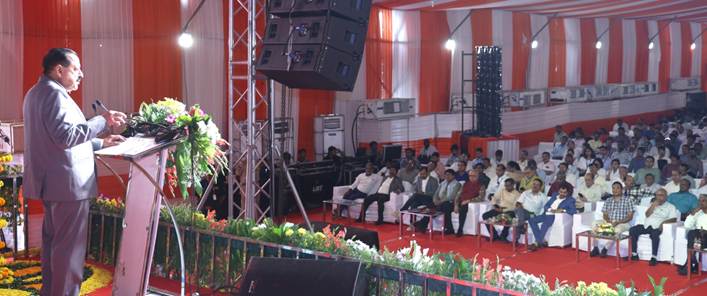
Union Minister of State for Science and Technology, Earth Sciences, and other key portfolios, Jitendra Singh, has emphasized the need for a seamless integration of innovation and industry to establish a globally competitive and sustainable startup ecosystem in India. Speaking at the Startup Conclave in Hyderabad, organized by CSIR-IICT, CSIR-CCMB, and CSIR-NGRI, Singh stated that the time has come for Indian science to break traditional silos and actively engage with industry stakeholders, investors, and the broader public.
Addressing scientists, entrepreneurs, students, and policymakers, Singh praised the unique collaboration of the three Hyderabad-based CSIR laboratories, which he described as a reflection of Prime Minister Narendra Modi’s vision for inclusive innovation and governance. He underscored the necessity of transforming public perception of government research facilities, urging scientists to open their domains, particularly agricultural research, to farmers and end-users for direct interaction.
Singh highlighted the importance of early and sustained industry involvement in research, citing the success of CSIR’s Aroma Mission, where over 3,000 youth, many of them non-graduates, transitioned into successful agri-entrepreneurs, with minimum annual earnings reaching ₹60 million. He described this as an ideal blend of technology, livelihood, and dignity.
He pointed to India’s biotech revolution, noting that while there were only 50 biotech startups in 2014, the number has now exceeded 10,000. Biotech valuation has risen from $10 billion to nearly $170 billion, a transformation enabled by dedicated government policies such as Bio-E3 and the National Quantum Mission.
Singh addressed concerns about compartmentalization within CSIR and his ministry, revealing that he now conducts monthly joint meetings of all science departments, including Atomic Energy, Space, and Biotechnology, to align overlapping initiatives rather than duplicating efforts. He stressed that India’s ability to compete globally hinges on improving coordination within its research ecosystem.
Announcing plans to open up India’s nuclear sector, Singh remarked that secrecy in scientific endeavors must be reconsidered in today’s digital age, where global collaboration is more valuable than restricted access. He called for a demand-driven innovation model in which industry plays a proactive role in funding research from its inception.
Singh noted that while government support has increased substantially—CSIR and DSIR budgets have risen by more than 230 percent since 2014—sustainability ultimately requires self-sufficiency and deeper public-private collaboration. He warned that launching a startup is not the real challenge; ensuring long-term survival and success is the crucial test.
He underscored Hyderabad’s strategic role in leading India’s science-led development, given its rich scientific heritage and thriving technology sector. Singh stated that India’s rise in the Global Innovation Index, jumping from 81 to 39 in less than a decade, reflects the nation’s commitment to fostering innovation and empowering youth.
The conclave marked a pivotal moment in India’s journey towards democratizing science, enhancing industry-academia collaborations, and positioning the nation as a global powerhouse in research and innovation.